OSPP-2025 Automating Documentation and Release Workflows for Kmesh

Introduction
Hello everyone! I’m Yash Israni, an open-source enthusiast passionate about automation, DevOps practices, and building tools that eliminate repetitive manual work.
This summer, I had the privilege of participating in the Open-Source Promotion Plan (OSPP) 2025, where I collaborated with the Kmesh community to automate documentation and release workflows. Over the course of three months, I designed and implemented GitHub Actions pipelines that keep the Kmesh website always up-to-date, properly versioned, and reviewed for language quality.
In this blog, I’ll share my journey—from acceptance to project execution, the technical decisions I made, and the lessons I learned along the way.
OSPP Program – Overview
The Open-Source Promotion Plan (OSPP), organized by the Institute of Software, Chinese Academy of Sciences (ISCAS), gives students and early-career contributors the opportunity to gain hands-on experience by working on impactful open-source projects under the guidance of mentors.
Each term runs for about three months (1 July – 30 September in my case). Contributors not only deliver real-world features but also learn how large open-source communities operate.
My Acceptance
I have always enjoyed contributing to open source, and my interests naturally align with automation and cloud-native tooling. When I saw that Kmesh was offering projects under OSPP 2025, I was immediately drawn to their proposal for automating documentation workflows.
The project addressed a clear pain point: documentation updates and versioning were being done manually, often lagging behind releases. The opportunity to replace repetitive tasks with reliable automation felt both impactful and challenging.
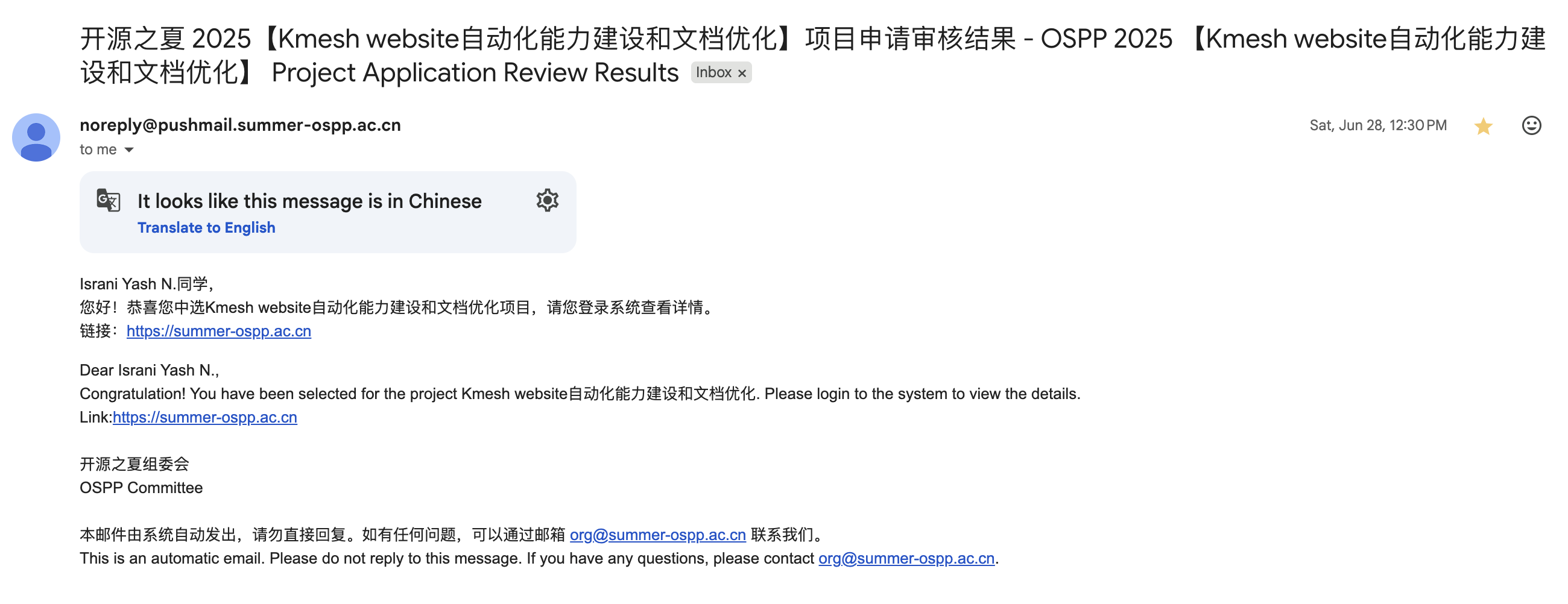
I received my acceptance email on 28 June 2025, and the program officially ran from 1 July to 30 September.
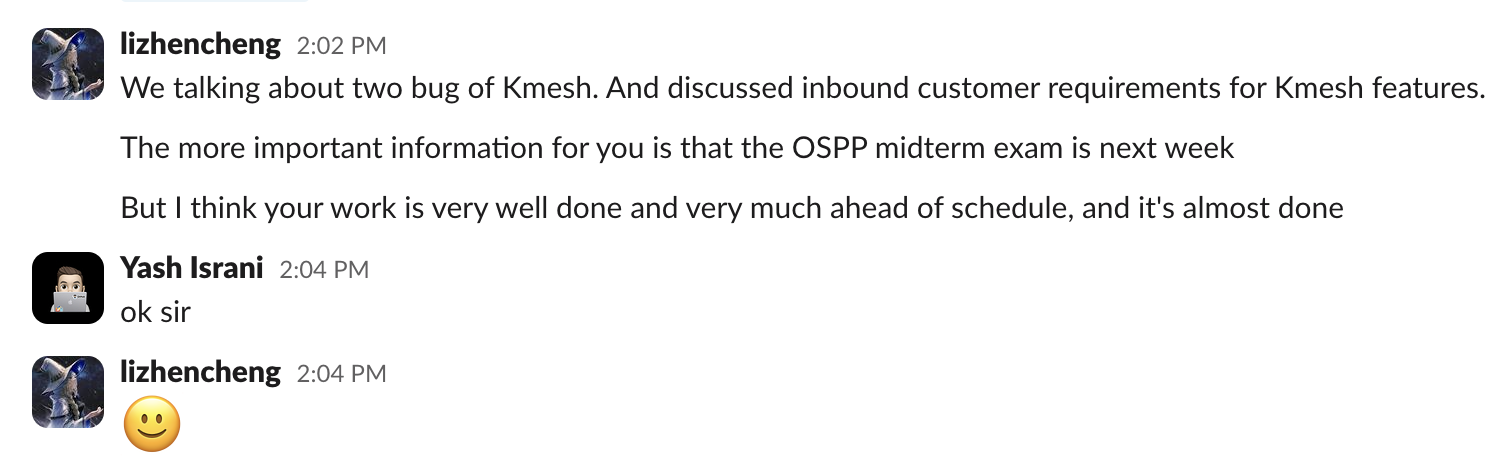
Interestingly, I was able to complete the majority of my project work before the mid-term evaluation, so that checkpoint was skipped, giving me extra time to refine the workflows and write proper usage guidelines.
Project Workthrough
1. Doc-Sync Workflow
- Trigger: on every push to the main branch
- Action: opens a pull request in the website repository with the latest documentation updates
- Enhancements: automatically labels the PR for triage and runs the site’s CI pipeline to validate changes
2. Release Versioning Workflow
- Trigger: when a new Git tag is pushed (release event)
- Action: generates a versioned snapshot of the documentation in the website repository
- Enhancements: automatically opens a PR for any versioning-related changes
3. Chinese Grammar Checker Workflow
- Trigger: on pull requests that modify Chinese documentation
- Action: uses the LanguageTool API to detect grammar and style issues
- Enhancements: posts line-level review comments as warnings (non-blocking) so contributors receive suggestions without being blocked from merging
Results
| Metric | Before (Manual) | After (Automated) | Improvement |
|---|---|---|---|
| Docs updated after release | 3–5 days | < 1 minute | >99% faster 🚀 |
| Website versioning updates | Delayed / inconsistent | Instant with each release | 100% reliable ✅ |
| Review time for Chinese docs | ~20 min per PR | ~1 min per PR | 95% time saved ⏱️ |
These workflows have effectively eliminated delays and manual errors, ensuring Kmesh documentation stays accurate and up-to-date.
All three workflows are now live in both the Kmesh main repository and website repository under .github/workflows.
Key Technical Decisions
- Adopted repository dispatch for secure cross-repo communication, eliminating the need for long-lived personal tokens
- Granted the GitHub Actions token read & write permissions only where necessary, while delegating other operations to a scoped bot account for better security
- Implemented Docusaurus-compatible versioning by dynamically generating
versions.json, keeping navigation in sync with releases - Added robust error handling in the doc-sync workflow to gracefully manage missing folders or files, preventing workflow crashes
Mentorship Experience
My mentors, Li Zhencheng and Zhonghu Xu, along with the Kmesh maintainers, were consistently supportive—whether through GitHub reviews or quick clarifications on Slack. Even though I delivered my main workflows ahead of schedule, their feedback helped me refine edge cases and improve overall reliability.
As a recognition of my contributions and active involvement, the Kmesh community welcomed me as a member of the organization. This acknowledgment was both humbling and motivating, and it strengthened my commitment to continue contributing to Kmesh and supporting its growth.
Lessons Learned
- Automation empowers humans – the goal isn’t to replace contributors but to free them from repetitive tasks so they can focus on meaningful reviews and design.
- Start small and iterate – building workflows in incremental, testable steps made debugging and maintenance far easier than deploying everything at once.
- Security matters – applying the principle of least privilege to tokens and permissions reduced risk while keeping automation safe.
- Expect edge cases – workflows behave differently across environments; testing on forks and multiple platforms prevented surprises in production.
- Documentation is part of the code – writing clear workflow descriptions and PR comments ensured maintainers trusted and understood what the automation was doing.
Acknowledgements
I would like to sincerely thank my mentors Li Zhencheng and Zhonghu Xu for their guidance, quick reviews, and encouragement. Thanks also to the OSPP program staff for ensuring smooth operations throughout the term.